
Adam Sewell: From a Camera and a University Placement to Great Britain
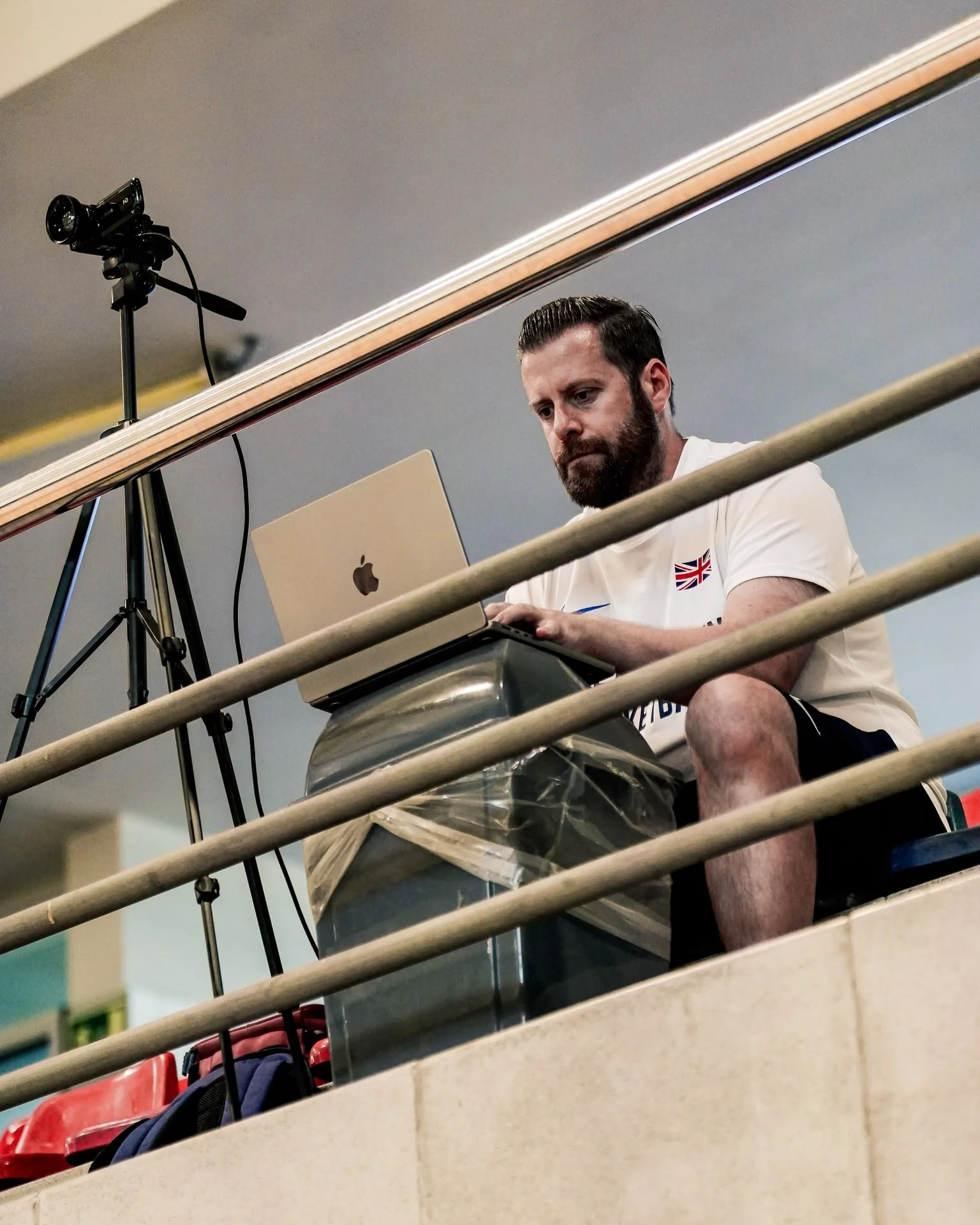
You don’t need to start in elite sport to build a career in it. For Adam Sewell, the journey to becoming Lead Performance Analyst for the Great Britain men’s team began with a university module, a placement filming Surrey Scorchers games and a camera that, 15 years later, he still uses.
It was an unexpected route into basketball’s high-performance environment, but one that brought together a number of interests and would develop into an applied career alongside his work in higher education.
“I studied sport and exercise science and in my second year we had an opportunity to select an option unit, one of which was performance analysis. With the support of my lecturer, Matt Robins, the unit gave me strong academic foundation and got me hooked.
“Between the applied statistics, the technology involved, and the fact it was a role within sports performance, it ticked a lot of boxes for me and I really enjoyed it. I also carried out a voluntary role with the Surrey Scorchers in my final year, filming games for them, so that was my first analysis role.”
Sewell came to university as a mature student. Basketball had been part of his life since he was around 14, although he never played to a high level. What mattered was the environment around the game, and the opportunity to remain involved in a sport he had always enjoyed.
.jpeg)
“I played basketball a little when I was younger, starting at around 13 or 14 at secondary school,” he said. “I didn’t play at a high level, but that was OK, as I really enjoyed the culture around the sport. I coached a little at university, but I’ve always really enjoyed being around the sport and the people within it. That’s what’s key for me.”
After graduating, Sewell began working as a Sports and Activities Manager, delivering the BUCS programme and student activities, while continuing to develop his experience in performance analysis through a Master’s degree. That combination has remained a feature of his career: his work in education and his applied experience in basketball have developed alongside one another.
Today, he is a lecturer at Bournemouth University, teaching across sports and exercise science and coaching programmes. His work includes teaching the principles of performance analysis, from using video analysis software to understanding how to effectively communicate insight to coaches and players. Sewell also helped develop Bournemouth University’s MSc in Sports Performance Analysis, drawing on his applied knowledge to help shape the programme’s framework.
It also gives him the opportunity to bring experience from the highest level of the game into the classroom, and to connect the academic principles with the realities of working in high-performance environments.
“There’s a nice synergy between what I do for Great Britain Basketball and the academic world.”
.jpeg)
His route through basketball has been built through a series of opportunities, starting with Surrey and progressing into the England age-group programmes, before getting the chance to intern with the senior men’s team.
A significant part of that development came through the Solent Kestrels, where he remained involved for five seasons after initially joining as part of his Master’s placement. Working with Head Coach Matt Guymon, Sewell was able to build his skills and practical understanding, gaining the trust to experiment with and develop the performance analysis provision at the club.
That experience helped lay the foundations for the role he holds today.
“I’ve been with the squad for nearly 50 games over a seven-year period. It feels like it’s gone very quickly, but I feel privileged to be in this position. It’s an honour to represent my country, and I now help lead the provision for the men’s programme, alongside an incredible group of players and staff.”
His work has also taken him to two major international tournaments, with Great Britain reaching EuroBasket in 2022 and 2025. It was the ambition he had set himself when he first entered the field.
“My goal when I started was to work in elite sport and to reach a major tournament with a team, and I’ve been fortunate enough to do that twice with Great Britain, reaching EuroBasket in 2022 and 2025. I feel very proud of what I’ve achieved so far, but I’m excited to see what’s next, keep developing and reframe my goals.”
The profession itself has changed considerably during that journey. When Sewell first worked with Surrey in 2013, game footage was recorded onto DVDs and sent to the league by post. Today, arena cameras and automated uploads have transformed the process, while advances in software and artificial intelligence continue to reshape what analysts can do.

For Sewell, AI presents a significant opportunity for analysts, helping to accelerate projects and develop tools that may previously have been difficult or time-consuming to create. However, he believes the technology will support the role of the analyst rather than replace it.
“AI gives analysts a great opportunity to accelerate projects and create tools that might otherwise have been difficult to develop. But there will always be a need for analysts because we are the experts in our field. AI doesn’t always get things right, and it’s our role to provide that tactical insight and understanding to players and coaches. For me, AI should be a supporting tool that enhances what we do and create efficiencies, rather than something that replaces the analyst anytime soon.”
It is an important distinction for anyone considering the field. Technology is a vital part of performance analysis, but the role goes far beyond operating software or collecting statistics. Analysts need to understand the demands of the sport, identify meaningful opportunities to support performance, and turn data into practical insight for coaches and players.
And for those interested in taking their first steps, Sewell’s advice is straightforward: start by getting involved.
“If anybody wants to get started on their journey, I’d suggest just reaching out to a club and seeing how you can support them. The level doesn’t matter. Starting at any National League or academy setting will allow you to have more of an impact on performance and give you opportunities to find which aspects of the discipline you enjoy and where you can excel.”
That first opportunity does not need to be particularly complex. Sewell points to the value of starting with simple tasks, such as filming games or recreating box scores for coaches, and learning what is useful within a team environment.
His own first investment was a camera, which he has continued to use throughout the 15 years since he began.
“It was an investment at the time but it removed a barrier to entry for me at the time and has allowed me to go on this incredible journey.”
For anyone watching from the outside, the distance between a first camera and the GB men’s programme might seem considerable. Sewell’s experience shows how that distance can be covered: through practical experience, a willingness to learn, and the confidence to reach out and offer support, even before who knows exactly where the opportunity might lead.
“If it interests you, just get involved and the rest will take care of yourself if you keep looking for opportunities and push yourself to grow.”
His journey is a reminder that there are many ways to contribute to basketball, and that a career in the sport does not have to begin with a professional playing or coaching pathway. Sometimes, it starts with a university module, a placement, or simply offering to help a local club.
For Sewell, that first step has led to a role at the heart of the Great Britain men’s programme — and, with new goals still to set, he is looking forward to what comes next.
Related News
-061026113706.webp)
Academy Leagues Preview (7 Oct 2026) - Live Stats, streaming, quotes and more
6 October 2026 4 min read-051026133559.webp)
NBL and WNBL Players of the Week - (3/4 Oct 2026)
5 October 2026 4 min read
Using the beauty of basketball to positively impact Portsmouth
5 October 2026 5 min read-051026102647.webp)
NBL D1 Recap (3/4 Oct 2026) - Live Stats, streaming, quotes and more
5 October 2026 5 min read